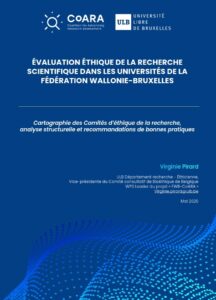
Mapping of Research Ethics Committees within the five universities of the Wallonia-Brussels Federation
While there have been a few studies devoted to identifying and analysing the functioning of research ethics committees, none to date has focused on the research ethics committees attached to the five universities of the Wallonia-Brussels Federation.
No recent study, it seems, has chosen to focus on the landscape of ethical evaluation of university research as a whole, rather than limiting itself to the research ethics committees that evaluate research in what is commonly referred to as the ‘biomedical’ field » but covering the entire range of research ethics committees active in the evaluation of research projects in universities, whether in the social sciences, law and criminology, educational sciences or engineering, to name but a few of the disciplinary fields concerned.
The rejection of a “balkanised” approach to research ethics committees based on their affiliation with a faculty or on the existence of a “hard law” legal framework does not stem from a desire to ignore the sometimes significant differences that exist between committees. It stems from a desire to reflect the breadth of the ethical evaluation landscape in the universities of the Wallonia-Brussels Federation and to understand precisely what connects – or should connect – these specific operators, namely the research ethics committees scattered throughout the university research ecosystem. This link, which is not always well understood because it is often not very explicit, stems from the particular social function of research ethics committees.
See the full report below!